TrialReadiness.com
Temporal design intelligence for clinical trialsMost Phase 2 failures aren’t drug failures.
In 1747, a ship’s surgeon named James Lind ran what is often called the first controlled clinical trial. Twelve scurvy-stricken sailors, six pairs, six remedies. One pair received citrus and was nearly back on duty within days. The sickest pair was assigned seawater — and got worse. Lind had a clear answer in under two weeks; it took the Royal Navy almost fifty years to act on it.
The signal was real, but fragile. A slightly different design — a citrus supply that ran out sooner, a shorter observation window, the wrong patients in the wrong arm — could have buried the very result that would later save thousands of lives. Trials still fail this way today: not because the molecule was wrong, but because the protocol could not have detected the signal even if it was there.
Trial design has come a long way — randomization solved bias, regulation brought accountability, adaptive designs added flexibility. But one dimension was never formally addressed: when you measure — the timing and density of assessments relative to the biology you are trying to detect. Most protocols set their timepoints around patient visit schedules, historical precedent, and operational convenience — not the biology. When measurement misses the mechanistic window, a trial can read as a drug failure when it was really a design failure. That gap is what Trial Readiness exists to close.
Before the trial runs
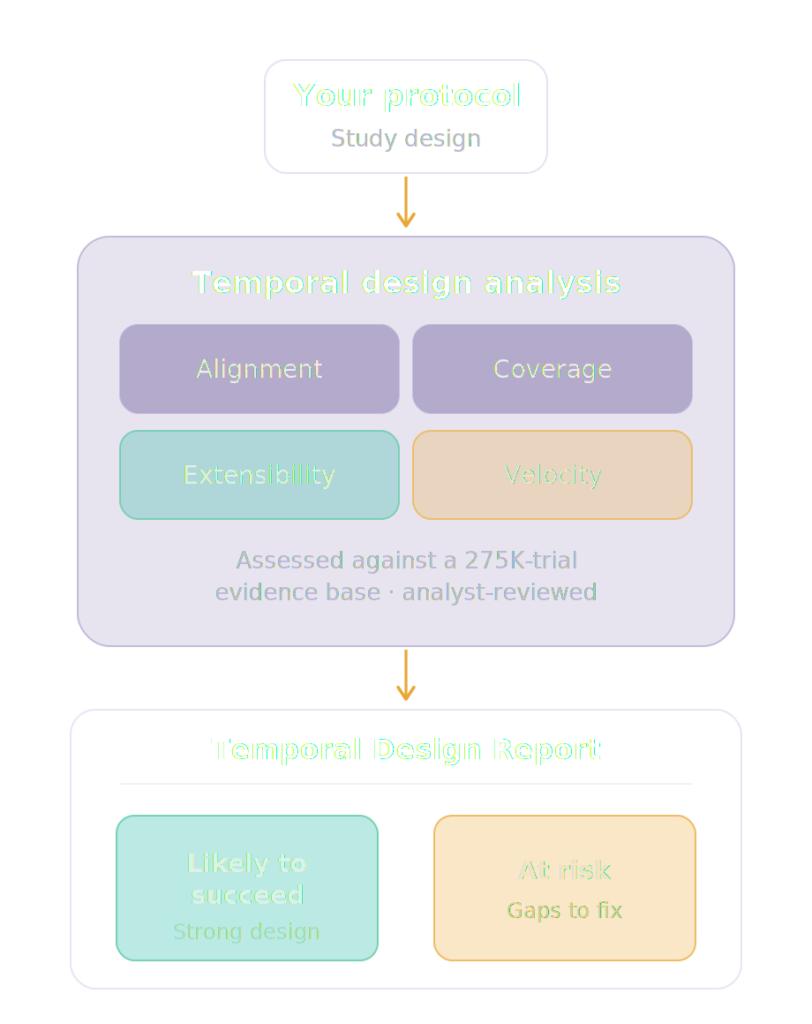
A structured look at a protocol’s temporal design before the first patient is enrolled, scoring the measurement architecture on a 0–40 scale — surfacing where it is strong, where it is fragile, and where a single design choice could decide whether a signal is detectable. Most recommendations re-allocate samples you are already collecting rather than adding patient visits.
Grounded in evidence
The analysis draws on a retrospective study of 275,000 trials, where temporal design quality was statistically associated with trial outcome across every therapeutic area tested. Delivered as an analyst-reviewed report, not an automated black box — built to be read and acted on by a clinical team.
Built for the partnering moment
For teams running exploratory programs meant to partner an asset, a clean readout is the difference between a deal and a polite pass. Trial Readiness focuses on the temporal design choices that most affect whether that readout lands — before the schedule of assessments is locked and amendments get expensive.
We are currently partnering with a small number of teams — especially in oncology — to run prospective analyses under NDA. If the timing of your assessments could be the difference between a clear readout and an ambiguous one, we would value a conversation. To schedule a 1:1 at BIO or anytime, email Chris Hoover at chris@scientari.com.
Explore the methodology, evidence, and engagement formats at trialreadiness.com.